
A branched macromolecule format creates a dense, tunable molecular structure.
Science / Platform
Engineering macromolecules
for muscle protection
Bottlebrush molecular architecture opens a differentiated physical approach to stabilizing mechanically stressed cell membranes.
The biological challenge
A fragile membrane sits at the center of muscle damage
The sarcolemma is the membrane surrounding each muscle fiber. In Duchenne muscular dystrophy, the absence of functional dystrophin makes this membrane vulnerable to repeated contraction-induced damage.
This damage allows dysregulated movement of ions and other molecules across the membrane, contributing to progressive loss of functional muscle tissue.
The Elymus platform
Elymers™ are engineered bottlebrush macromolecules designed to combine nanoscale architecture with membrane engagement
Amphiphilic structures are designed to interact with the lipid bilayer.
The intended result is physical membrane stabilization under mechanical stress.
Mechanism overview
Elymer™ proposed mechanism
of action
Hypothesis on action of the macromolecule on the lipid bilayer: patch, repair and heal.
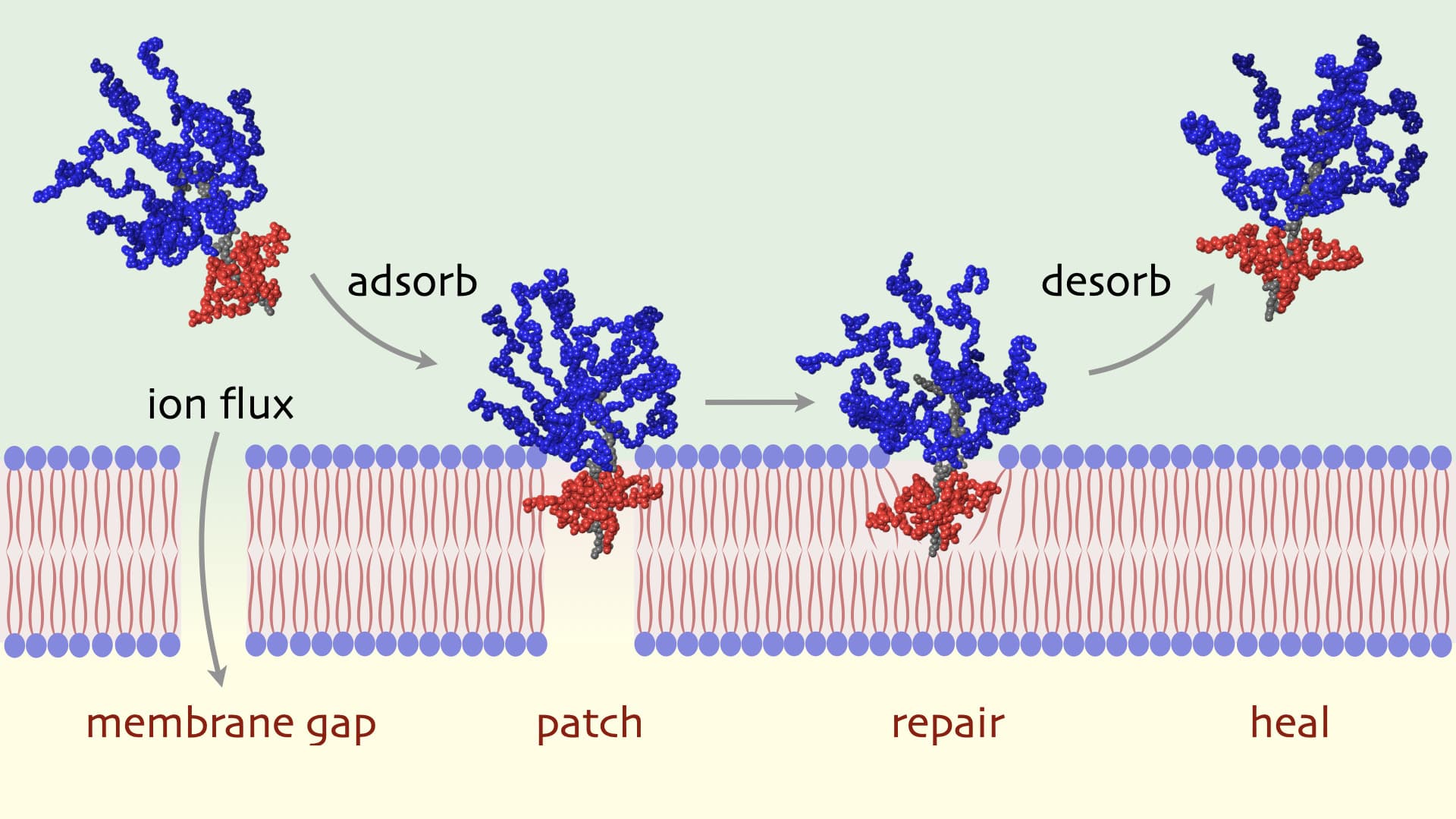
01Patch
Evidence framework
From molecular behavior to physiological performance
01Molecular characterization02Membrane-binding studies03Cellular protection04Preclinical physiology